
When a business starts growing with Salesforce, the platform quickly becomes more than just a CRM. It becomes the operational backbone for sales, customer service, reporting, automation, marketing, and decision-making. But as the business scales, managing Salesforce becomes more complex and resource-intensive.
At some point, companies face a critical question:
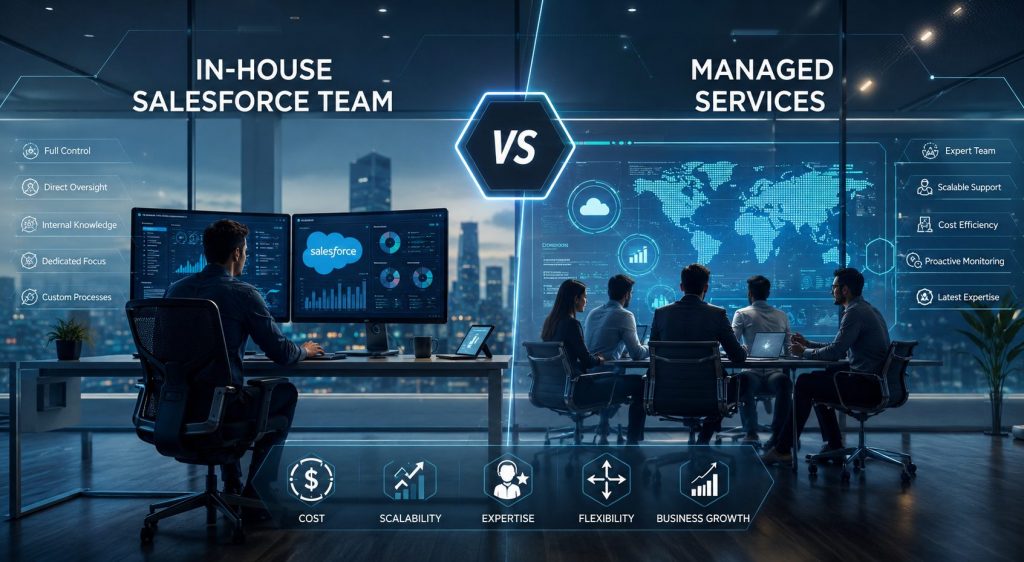
Should you build an in-house Salesforce team or partner with a Salesforce managed services provider?
This debate usually involves multiple stakeholders. The CTO wants control and technical ownership. The CFO focuses on cost efficiency. Sales leadership wants a system that works without delays. Every perspective is valid, but the decision is often made without evaluating the long-term operational impact.
The right answer depends on your organization’s complexity, growth plans, workload, and internal capabilities. This guide breaks down the real differences between an in-house Salesforce team and Salesforce managed services, helping you make a more informed decision.
What Are You Actually Choosing Between?
The term “in-house Salesforce team” can mean very different things depending on the organization.
For some businesses, it is a single Salesforce administrator handling:
- User management
- Reports and dashboards
- Workflow updates
- Day-to-day support
For larger organizations, it may include:
- Salesforce developers
- Business analysts
- Solution architects
- Integration specialists
- Dedicated Salesforce product owners
Each structure comes with different costs, capabilities, and management overhead.
The same applies to Salesforce managed services.
Some managed service providers only offer limited admin support on a monthly retainer. Others function as a complete extension of your team, covering:
- Salesforce administration
- Development
- Release management
- Integrations
- Automation maintenance
- Strategic roadmap planning
- AI readiness support
The real comparison is not simply in-house vs outsourced Salesforce support.
It is your current internal capability versus the level of expertise your business actually requires.
5 Key Factors to Consider Before Choosing Salesforce Managed Services or an In-House Team
1. How Complex Is Your Salesforce Environment?
A basic Sales Cloud setup with 50 users is very different from a multi-cloud Salesforce ecosystem with:
- Sales Cloud
- Service Cloud
- Marketing Cloud
- Data Cloud
- ERP integrations
- AI tools
- Multiple business units
As Salesforce environments grow, so does the need for specialized expertise.
A single in-house Salesforce admin may be excellent at configuration and reporting, but modern Salesforce ecosystems require expertise across multiple areas:
- Apex development
- Integrations
- Security
- Automation architecture
- Marketing Cloud
- Data management
- AI implementation
No single person can realistically specialize in every Salesforce product and release cycle.
This is where Salesforce managed services offer a structural advantage. A managed services partner gives businesses access to a broader team of specialists, including:
- Salesforce developers
- Architects
- Integration experts
- Automation specialists
- Security consultants
If your Salesforce environment is relatively simple and stable, an in-house admin may be enough. But if your roadmap includes growth, integrations, AI capabilities, or multiple Salesforce clouds, managed services often provide better long-term scalability.
2. What Does an In-House Salesforce Team Really Cost?
Many companies underestimate the true cost of managing Salesforce internally.
A mid-level Salesforce administrator in the US typically costs:
- $85,000–$110,000 base salary
- Additional 25–30% for benefits, taxes, and insurance
- Ongoing certification and training costs
- Recruitment and onboarding expenses
Beyond salary, there are hidden operational costs:
- Time spent solving unfamiliar technical issues
- External consultants hired for specialized projects
- Delays caused by skill gaps
- Productivity loss during hiring transitions
Even highly capable internal teams eventually encounter challenges outside their expertise.
By comparison, Salesforce managed services pricing is generally structured around a predictable monthly retainer. Depending on scope and complexity, businesses typically invest between:
- $3,000–$10,000 per month
This often includes:
- Administration
- Development
- Release management
- Automation support
- Strategic consulting
- Security reviews
The key difference is flexibility. Managed services provide access to multiple skill sets without the cost and complexity of hiring a full internal Salesforce department.
3. What Is Your Single Point of Failure Risk?
This is one of the most overlooked risks in Salesforce management.
When a business relies on a single in-house Salesforce administrator, that person becomes a critical operational dependency.
If they leave:
- Documentation may be incomplete
- Automations may become difficult to maintain
- Integrations may break without clear ownership
- Business operations can slow down immediately
Replacing Salesforce talent is rarely fast. Hiring and onboarding a new Salesforce admin can take several months before productivity stabilizes.
Salesforce managed services reduce this risk through team-based continuity.
A managed services provider typically maintains:
- Shared documentation
- Process visibility
- Multiple technical resources
- Defined SLAs (service-level agreements)
This means your Salesforce support does not disappear when one individual leaves the project.
For organizations prioritizing operational stability, this continuity is often one of the strongest arguments for managed services.
4. How Strategic Is Salesforce to Your Business?
For some organizations, Salesforce is deeply embedded into every business function. In these cases, maintaining strong internal ownership is valuable because Salesforce directly supports competitive advantage.
For other businesses, Salesforce is essential infrastructure but not a core differentiator. The priority is simply ensuring the platform runs efficiently and scales reliably.
This distinction matters.
Even companies using Salesforce managed services often benefit from having:
- An internal Salesforce owner
- A CRM manager
- A business stakeholder responsible for prioritization
The internal team provides business context and strategic direction, while the managed services partner handles technical execution and scalability.
This hybrid approach is increasingly common because it balances:
- Internal ownership
- External expertise
- Operational flexibility
5. How Consistent Is Your Salesforce Workload?
Not every business has a steady Salesforce workload.
Some companies require:
- Continuous development
- Frequent integrations
- Ongoing optimization
Others experience fluctuating demand:
- A major implementation project
- Followed by months of lighter maintenance work
An in-house team represents fixed capacity. During slower periods, resources may be underutilized. During peak demand, internal teams often become overwhelmed.
Salesforce managed services offer flexibility that internal hiring cannot easily match.
Businesses can:
- Scale hours up or down
- Add specialized expertise temporarily
- Support large projects without permanent hiring
- Reduce operational bottlenecks
For organizations with changing business priorities, managed services provide significantly more agility.
Why Many Businesses Choose a Hybrid Salesforce Support Model
In practice, most successful organizations do not choose exclusively between in-house teams and managed services.
Instead, they combine both.
A common hybrid model includes:
- One internal Salesforce owner
- A Salesforce managed services partner for technical execution
This structure works well because:
- Internal teams understand business priorities
- External experts provide technical depth and scalability
The balance varies depending on:
- Organization size
- Salesforce complexity
- Internal technical maturity
- Growth plans
For many growing businesses, this model delivers the best combination of:
- Cost efficiency
- Platform stability
- Access to expertise
- Long-term scalability
Signs Your Current Salesforce Support Model Is Not Working
Many organizations only reconsider their Salesforce support structure after problems start affecting operations.
Common warning signs include:
- Growing backlog of Salesforce requests
- Frequent automation errors
- Slow implementation timelines
- Poor user adoption
- Incomplete documentation
- Overdependence on one admin
- Difficulty supporting integrations or new clouds
The immediate instinct is often to hire another Salesforce resource.
Sometimes that works. But in many cases, the issue is not simply headcount. It is a broader capability gap requiring:
- Specialized expertise
- Better processes
- Faster execution
- Stronger governance
A Salesforce managed services partner can often stabilize an environment much faster than internal hiring alone.
How Sarla Consulting Approaches Salesforce Managed Services
At Sarla Consulting, we provide Salesforce managed services for small and midsize organizations looking for scalable, reliable Salesforce support.
| Service Area | What It Covers |
| Ongoing administration | User management, permission sets, configuration changes, report and dashboard updates, and minor enhancements |
| Release management | Review of Salesforce’s three annual major releases; identification of relevant new features; deployment of safe and useful updates |
| Automation maintenance | Monitoring and maintenance of flows, triggers, and integrations; resolving errors before they affect users |
| Development and enhancement | Building new functionality, custom objects, integrations, and more complex configuration changes |
| Data quality governance | Regular data audits, duplicate management, validation rule review, and data cleanup |
| Security reviews | Quarterly review of profiles, permission sets, session settings, and connected app access |
| Strategic roadmap support | Working with internal stakeholders to plan the next phase of Salesforce use — new clouds, AI readiness, integrations |
| Health check and documentation | Maintaining current documentation of the org’s architecture and flagging risks before they become problems |
Choosing the Right Salesforce Support Model for Long-Term Growth
The decision between an in-house Salesforce team and Salesforce managed services is not simply about cost. It is about:
- Capability
- Scalability
- Risk management
- Operational continuity
- Business alignment
A simple Salesforce environment may work well with a small internal team. But as complexity increases, businesses often need broader expertise and more flexible support structures.
For many organizations, the best solution is a hybrid approach that combines internal business ownership with external Salesforce expertise.
The key is choosing a model that supports your business today while remaining flexible enough for where your Salesforce ecosystem is heading next.
idpitaslot
Everything about this place feels welcoming. The promos are genuine and not just bait. I’m really enjoying my time at idpitaslot.
idpitaslot
Everything about this place feels welcoming. The promos are genuine and not just bait. I’m really enjoying my time at idpitaslot.
idpitaslot
Everything about this place feels welcoming. The promos are genuine and not just bait. I’m really enjoying my time at idpitaslot.
idharta328
Really impressed with the bonus offers they have for new members. It gave me a great head start. If you are looking for value, give idharta328 a try.
idharta328
Really impressed with the bonus offers they have for new members. It gave me a great head start. If you are looking for value, give idharta328 a try.
jljl2login
Great platform with a lot of exciting options. The registration was a breeze and jljl2login provides a very stable connection even during peak hours.
jljl2login
Great platform with a lot of exciting options. The registration was a breeze and jljl2login provides a very stable connection even during peak hours.
idsupermpo
I’ve been trying a few platforms lately and this one really stands out. The interface is smooth and the payouts are surprisingly fast. Definitely check out idsupermpo if you want a reliable spot.
idsupermpo
I’ve been trying a few platforms lately and this one really stands out. The interface is smooth and the payouts are surprisingly fast. Definitely check out idsupermpo if you want a reliable spot.
idsupermpo
I’ve been trying a few platforms lately and this one really stands out. The interface is smooth and the payouts are surprisingly fast. Definitely check out idsupermpo if you want a reliable spot.