
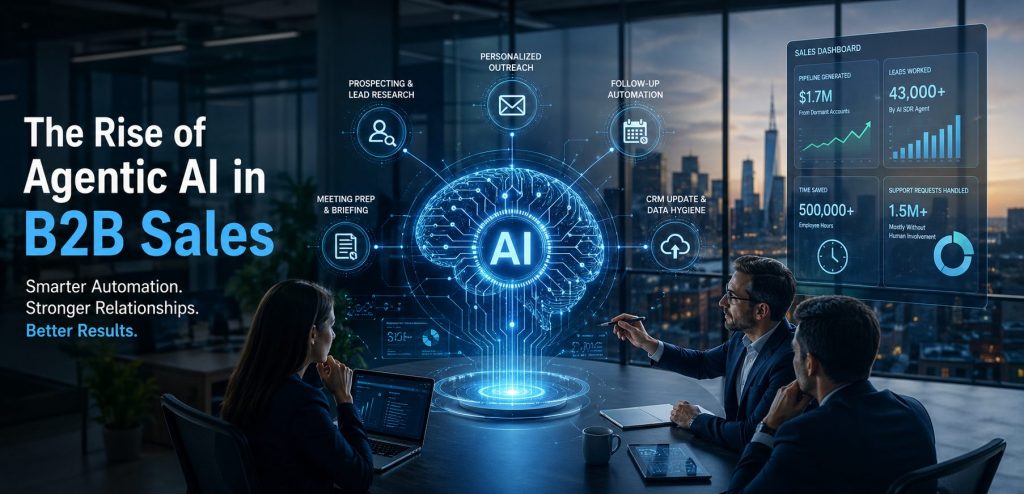
Most companies already have some form of automation in their sales stack like email sequences, CRM auto-logging, chatbots, basic workflow rules. These tools execute fixed instructions. You define the trigger and the action, and the tool runs the script. If something outside the script happens, the tool stops and waits for a human.
Agentic AI is different in a specific and important way. It is goal-oriented. You give it an objective, and it decides how to pursue that objective, what steps to take, which tools to use, and how to adjust when something unexpected comes up.
Gartner called this shift a ‘major evolution’ beyond generative tools in their 2025 market analysis. The global agentic AI market was valued at $5.25 billion in 2024 and is projected to reach $199 billion by 2034. It is a compound annual growth rate of nearly 44 percent. Those numbers reflect what happens when technology moves from answering questions to actually doing work.
What Agentic AI Does in B2B Sales Organizations
The clearest way to understand agentic AI in B2B sales is to look at where reps currently spend time, and where an agent would take that work instead.
Prospecting is the most obvious starting point. A traditional SDR might spend two to three hours a day working on the assigned tasks. An agentic system does this continuously, in real time, without being asked. When your rep arrives in the morning, the list of accounts worth calling is already built and ranked.
Follow-up is where most deals go quiet. Research consistently shows that most B2B sales require between five and twelve touchpoints to close, but the majority of reps stop after two or three. An agentic system monitors engagement signals and automatically schedules and drafts follow-up outreach timed to those signals, without the rep having to remember.
CRM hygiene is a quieter but equally large problem. Reps enter data because they have no choice. The result is records that are incomplete or simply wrong, which makes every report, forecast, and AI insight built on top of that data unreliable. Agentic systems update CRM records based on what actually happens. The data stays current because the agent maintains it.
Salesforce Agentforce Case Study and AI Sales Automation Results
In 2024, Salesforce deployed Agentforce across its own internal operations. A year later, they published what they found.
The SDR agent worked more than 43,000 leads and generated $1.7 million in new pipeline, specifically from dormant accounts. The agent just kept working through the list, reaching out with personalized context at appropriate intervals, and surfacing the ones that responded.
Across the organization, Agentforce in Slack returned an estimated 500,000 hours of employee time in the first year by handling routine tasks. Their service agent handled 1.5 million support requests, the majority without human involvement.
The lesson from their own experience was not that AI replaces people. It was the AI that took on the work that should never have been human work in the first place, and the people got their time back for the work that actually requires relationship, and trust.
Limitations of Agentic AI in B2B Sales
The 3.7x quota attainment figure from Gartner is real, but it comes with an important qualifier. It applies to sellers who effectively partner with AI.
Agentic AI produces value when it is properly connected to clean data, well-defined objectives, and a team that actually uses the outputs. When it is bolted onto a CRM with inconsistent records or ignored by reps who do not trust what it surfaces, the results are predictably poor.
The best implementations of agentic AI in B2B sales understand this boundary clearly. The agent handles everything up to the point where human judgment creates the most value. Then it steps aside.
AI vs Human Roles in B2B Sales and CRM Automation
| Task | Best Handled By | Why |
| Account research and ICP scoring | AI agent | Processes hundreds of signals simultaneously; no fatigue; updates continuously |
| Initial outreach sequencing | AI agent | Personalizes at scale; optimizes timing; tracks engagement without manual effort |
| CRM data entry and maintenance | AI agent | Eliminates manual input error; keeps records current after every interaction |
| Follow-up cadence management | AI agent | Monitors signals across the full territory; no dropped threads regardless of territory size |
| Meeting preparation and briefing | AI agent | Pulls account history, recent activity, and talking points before every call |
| Qualification scoring and pipeline risk flags | AI agent + rep review | AI identifies patterns; rep applies contextual judgment |
| Discovery conversation and needs assessment | Human rep | Requires listening, intuition, and real-time adaptation to what is unsaid |
| Complex negotiation and closing | Human rep | Depends on relationship trust, credibility, and in-the-moment decision-making |
| Stakeholder alignment and executive engagement | Human rep | Requires empathy, presence, and political awareness that AI cannot replicate |
How to Implement Agentic AI in Salesforce and Sales Workflows
Most sales organizations that are thinking about agentic AI are not starting from scratch. They already have Salesforce. They already have some automations. They may already be using Einstein features for forecasting or lead scoring. The question is which workflows to give to an agent first, and what needs to be in place before that works.
The answer almost always starts with data. An agentic system is only as useful as the information it works from. If your Salesforce CRM has stale contact records or fields that reps ignore, the agent will either make poor decisions or surface outputs that reps immediately distrust. Getting the data foundation right is the work that makes everything else possible.
After that, the most productive starting points tend to be the tasks that are highest in volume and most consistently dropped, follow-up sequencing, meeting prep summaries, lead research, and CRM updates from completed activities. These produce visible time savings quickly, which builds the organizational confidence to go further.
Sarla Consulting helps organizations implement Salesforce Agentforce and the underlying CRM infrastructure that makes AI agents actually work. We have been doing Salesforce implementations for over 15 years, which means we have learned that AI on top of a poorly maintained org produces AI-powered confusion.
We are not here to sell AI as a concept. We have seen what happens when it is implemented on top of bad data, without user buy-in, or without a clear view of which human tasks it is meant to replace. That version does not work. The version that does work takes the preparation seriously, and then the results tend to be genuinely significant.
If your team is spending 70 percent of their week on tasks that are not selling, there is a version of your sales org where that number is very different. The technology to get there is available now. What takes work is building the foundation that makes it reliable.
Rene Jon Emilio Gilbert
The positivity and optimism conveyed in this blog never fails to uplift my spirits Thank you for spreading joy and positivity in the world