In July 2024, Hurricane Beryl tore through Houston. The storm knocked out power to more than 2.7 million CenterPoint Energy customers. As residents scrambled for updates, people were getting more accurate outage information from a fast-food chain than from their own power company.
Whataburger, the Texas burger chain, shared accidental data that turned out to be more reliable than the official word from the utility. On the other hand, different departments using disconnected systems were not able to see the full picture in real time.
This story should bother anyone running a utility company because the gap that made it possible was entirely preventable.
When a line goes down, information about it usually sits in at least three separate places: the outage management system, field dispatch platform, and customer service database. A customer who calls to report no power gets connected to an agent who has no visibility into what a crew is doing two blocks away. The agent makes a promise they can’t back up. This pattern repeats across tens of thousands of households.
When the Actual Problems Are the Silos (Siloed Systems in Utilities)
This is what the technology world calls a “siloed system” – where data is trapped in separate tools that don’t communicate. In the energy and utilities sector, this is still surprisingly common, even in large organizations.
The numbers highlight the cost:
- Pennsylvania’s Public Utility Commission reported 71 reportable outage events in 2024, the highest in over 30 years.
- More than 2.8 million residents lost power during the year.
- In New York, regulators fined five utilities a combined $28.9 million in 2025 for poor customer service performance during outages.
What Salesforce Brings to the Energy & Utilities Sector
Salesforce Energy & Utilities Cloud offers pre-built workflows designed specifically for the industry, including:
- Meter installations
- Vegetation management
- Planned maintenance visits
- Short-cycle field tasks (reconnections, shutoffs)
- Storm response management at scale
The core idea is a unified customer view – a single record accessible across departments.
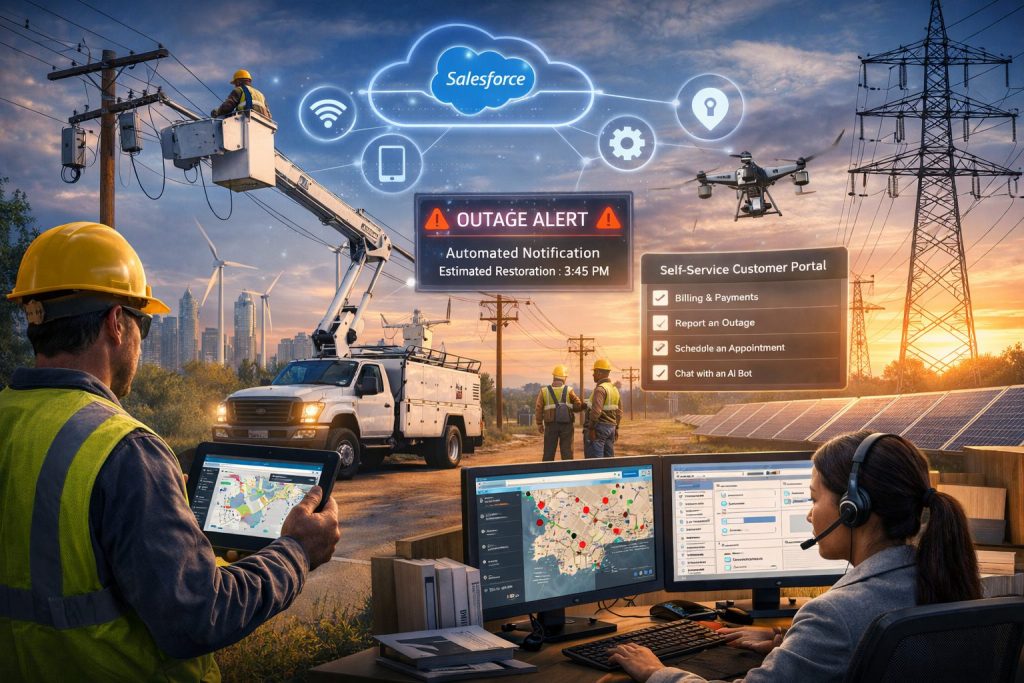
When a field crew closes a job, a customer service agent sees it instantly. When a customer reports a gas smell, a work order is automatically created, a technician is assigned, and the customer receives a confirmation.
Improved Customer Experience with Digital Self-Service
On the customer side, this enables:
- Self-service utility portals
- Billing support without calls
- Appointment scheduling
- Program enrollment
According to IDC, 45% of energy suppliers plan to adopt AI chatbots, reducing contact center volume by over 60% during non-emergency periods.
Case Study: Florida Power & Light (FPL) Salesforce Implementation
NextEra Energy’s Florida Power & Light (FPL) operates one of the most advanced Salesforce utility implementations, showcased at Dreamforce 2024.
Their setup combines:
- Salesforce Service Cloud
- Salesforce Field Service
- Energy & Utilities Cloud
During major outages or storms:
- Field crews are dispatched in real time
- Automated outage notifications are sent by location
- Restoration estimates update dynamically
- Customers receive updates without contacting support
This system is widely recognized for treating outage management as a customer experience function, not just an operational issue.
Transforming Field Operations with Salesforce Field Service
While customer experience gets attention, field operations optimization is equally critical.
Salesforce Field Service equips technicians with a Prework Brief, a mobile job summary that includes:
- Customer history
- Asset data
- Safety flags
This ensures technicians arrive prepared, reducing repeat visits and delays.
Key Capabilities:
- Digital work order management (creation to closure)
- Real-time crew tracking and dispatch
- Predictive maintenance using IoT/sensor data
- Mobile-first workflows for modern workforce needs
For utilities onboarding younger technicians, digitized field service operations are essential.
Traditional vs Modern Utility Operations (With Salesforce)
| Process | Old Way | New Way (Salesforce) | Customer Impact |
|---|---|---|---|
| Outage Communication | Manual calls / static updates | Automated real-time alerts | Faster updates, less frustration |
| Work Order Creation | Manual / paper-based | Auto-generated from reports or sensors | Faster response |
| Field Crew Dispatch | Disconnected systems | Unified CRM + dispatch | Better service efficiency |
| Restoration Updates | Delayed agent communication | Instant notifications | Real-time transparency |
| Billing Support | Call center dependent | Self-service portals & AI chatbots | 24/7 access |
The Expertise of Sarla Consulting in Salesforce for Utilities
Here’s what that work typically involves:
Salesforce Energy & Utilities Solutions
| What We Do | What It Solves |
|---|---|
| Salesforce Energy & Utilities Cloud implementation | Replaces disconnected outage, dispatch, and CRM systems |
| Field Service configuration | Enables real-time dispatch & mobile workforce management |
| Outage communication workflows | Automates customer notifications at every stage |
| Customer self-service portals | Reduces call volume with digital experiences |
| CRM data consolidation | Creates a unified customer view |
| Managed services & support | Ensures long-term system performance |
We don’t push a standard template onto every utility client. The gaps at a mid-sized regional provider differ from those at a large investor-owned utility.
We start by analyzing:
- Existing utility IT systems integration
- Customer service gaps
- Operational inefficiencies
- Regulatory risks
Then we build a custom Salesforce implementation for utilities that improves both operations and customer satisfaction.
The Future of Utility Operations is Connected
The gap that caused confusion during Hurricane Beryl wasn’t about effort – it was about systems not talking to each other.
With platforms like Salesforce for energy and utilities, companies can:
- Eliminate data silos
- Improve outage communication
- Optimize field service operations
- Deliver better customer experiences
Because in today’s environment, reliability isn’t just about keeping the lights on – it’s about keeping customers informed.