
Most nonprofit development directors can tell you their grant deadlines from memory. Because missing one is too costly to risk leaving it to a system they do not trust.
Spreadsheets get shared and then forgotten. Email threads hold critical compliance notes that nobody can find six months later. The finance team is working off one number while the program team is working off another. When a funder asks for a mid-year progress report, someone spends two days pulling data from three different places and hoping the numbers are consistent.
This is an infrastructure problem. And for nonprofits that have moved their grant operations onto Salesforce, it largely goes away.
This guide explains how Salesforce grant management works across the full lifecycle. It also covers what Agentforce Nonprofit adds to that picture with AI-driven automation, and what a proper implementation actually requires to deliver on that promise.
What Poor Grant Infrastructure Actually Costs
The most-cited number is staff time. That is accurate, but it undersells the problem. The real cost of a broken grants management process shows up in four places:
- Missed deadlines: Grant success rates for nonprofits average around 10%, even when applications are submitted on time. Grants submitted early are won at roughly 60%; those submitted late, around 25%. A missed deadline is a damaged relationship with a funder that may take years to rebuild, if it gets rebuilt at all.
- Compliance exposure: As of October 2024, nonprofits expending $1 million or more in federal awards must undergo a single audit. Missing required documentation, reporting elements, or restricted fund tracking can trigger repayment demands and corrective action plans.
- Knowledge loss: When a grants manager leaves, what leaves with them depends almost entirely on your systems. In organizations without centralized grant records, the answer is the entire institutional memory of funder relationships, past proposals, compliance history, and program officer preferences. The next person starts from nothing.
How Salesforce Structures Grant Management
Before getting into what Agentforce Nonprofit adds, it helps to understand what the Salesforce data model for grant management looks like underneath.
Salesforce Nonprofit Cloud (now rebranded as Agentforce Nonprofit as of October 2025) uses a native grantmaking data model built around several core objects:
Funding Opportunity records represent the available pool of money for a specific program. These records connect to Application Timelines to track milestone dates in the application process, and to Budget records showing how the pool of money should be used across the award period.
Individual Application records capture each grant request. They hold the funding opportunity, the applying account or contact, the budget requested, and the stated purpose. These are generated when applicants submit through the Grantmaking portal.
Application Review records document who reviewed each application, what they recommended, and the current decision status. This keeps the review process auditable and moving.
Funding Award records represent the actual award given to a person or organization. They track the amount, the program, the related funding opportunity, and the awardee, with a Budget tab for recording both planned distribution and actual disbursements.
On the grantee side, grants are stored as Opportunity records within the Salesforce data model, associated with specific programs and their deliverables. Payment schedules, deliverable records, and compliance tracking all attach to this central record.
The result is a single system where funder accounts, contact history, proposal history, award terms, compliance requirements, and program outcome data all live together.
The Grant Lifecycle in Salesforce
Prospect Research and Pipeline Tracking
Every funder your organization has ever engaged with lives in Salesforce as an Account record, with a complete relationship history attached. Contact records capture program officer names, communication preferences, and meeting notes. When a new team member needs to understand your history with a funder, they open one record and read the full picture in minutes.
Grant prospects move through a pipeline tracked as Opportunity records, with stages configured to match your actual workflow. This view gives development directors a clear picture of ongoing and prospective clients.
Salesforce Flows can trigger automated deadline reminders before key dates. This alone eliminates most of the missed-deadline risk.
Award and Compliance Tracking
When a grant is awarded, the Opportunity record updates to reflect the current status of the pay. If the grant arrives in installments, payment schedules track each disbursement against the planned budget.
Restricted fund compliance is one of the areas where spreadsheet-based systems fail most often. Salesforce tracks restricted funds separately with Gift Designations, showing exactly how donor-directed dollars are earmarked and spent. Finance teams and program staff are looking at the same data, so the narrative in the grant report matches the financial statements without manual reconciliation.
Document checklists and verification records inside the Grantmaking module let teams track the status of the compliance material. An audit trail of every update is built into the system by default.
Reporting and Funder Stewardship
This is where Salesforce creates the clearest operational advantage. When program data and grant data share the same system, reports almost write themselves. Outcome data includes the participants served, service hours delivered, and milestones hit. It connects directly to the grant records they support. Instead of pulling numbers from a separate program database and hoping they match the development team’s records, along with other details.
Salesforce reports and dashboards can be configured to generate real-time grant progress summaries. These become the foundation for funder reports rather than a starting-from-scratch writing exercise.
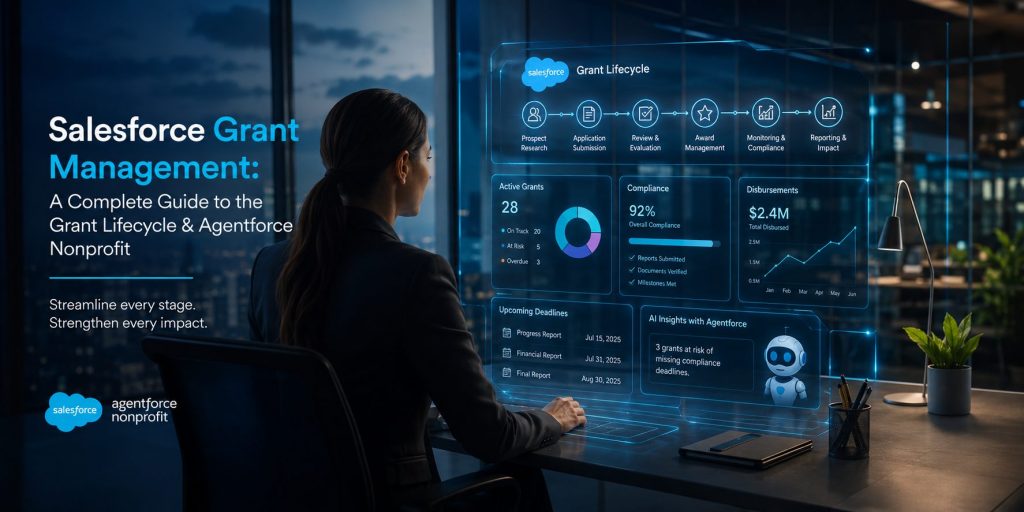
For organizations managing multiple grants simultaneously, a grants dashboard gives the full portfolio view at a glance.
What Agentforce Nonprofit Adds to Grant Management
Nonprofit Cloud as a static CRM was already a substantial improvement over spreadsheets. Agentforce Nonprofit takes the same data foundation and makes it active.
The difference is that a static CRM stores and retrieves grant data. Agentforce agents act on it. Specifically for grant management:
Automated grant progress summaries. Einstein can generate a summary of how a grant is tracking against its indicators on demand, without anyone needing to run a report. A development manager can ask the system, “How is the Johnson Foundation grant tracking against our Q2 targets?” and receive an answer in seconds rather than submitting a data request.
AI-assisted report drafting. For funder reports that require narrative alongside data, Agentforce can draft a distilled version of a grant application or progress report for board review, drawing on the program data already in the system. This gives them a structured starting point rather than a blank page.
Deadline monitoring and alerts. Agentforce agents monitor grant deadlines and flag approaching dates proactively, without waiting for someone to run a report or check a calendar.
Prospect Research Agent. For the pre-award phase, this prebuilt agent surfaces funder details directly in Slack before a prospect meeting so the development team walks in prepared rather than digging through records manually.
What a Grant Management Implementation Actually Requires
The platform capability is real. But the results depend heavily on how the implementation is structured. Here is what organizations consistently get wrong.
Data readiness before go-live
Agentforce agents operate on your CRM data. If funder records are incomplete, the agents will reflect those gaps. An AI-powered summary of a grant with incomplete records in Salesforce will be an AI-powered summary of incomplete records. Getting the data right before implementation is not optional.
Workflow design that matches how your team works
Out-of-the-box Salesforce can track grants. What makes it work for your organization is configuring the stage names, the deliverable records, the compliance checklist fields, the dashboard layouts, and the automation triggers to match your actual grant process. This is where implementation expertise matters. A Salesforce consultant who has never worked in nonprofit grant management will build something technically correct that nobody uses.
Cross-team alignment on data entry
The value of centralized grant data depends on all the teams entering data into the same system in a consistent way. If program managers log outcomes in a separate spreadsheet, those outcomes will not appear in the grant reports Salesforce generates. Implementation should include training and clear process documentation for all teams that touch grant-related data.
Starting small and expanding
The most common mistake in nonprofit Salesforce implementations is trying to configure everything at once. A more reliable path is to get core grant tracking working well first. Then layer in compliance tracking, then reporting automation, then Agentforce agents. Implementation typically takes 6 to 10 weeks, and the organizations usually see measurable impact within the first quarter.
NPSP vs. Agentforce Nonprofit: Which Is Right for Your Grant Operations?
Organizations already on Salesforce NPSP can use it for basic grant tracking. Opportunities serve as grant records; deliverable records track milestones; reports provide deadline views. For smaller nonprofits with straightforward grant portfolios, this works.
Where NPSP falls short is in the grantmaking data model. It does not have native Funding Opportunity, Individual Application, or Funding Award objects. Building those structures on NPSP requires custom development that Agentforce Nonprofit delivers out of the box.
Agentforce Nonprofit is the right choice for organizations that:
– Manage more than 10-15 active grants simultaneously
– Have complex reporting requirements across multiple funders
– Need to connect program outcome data directly to grant records
– Are you ready to use AI-driven automation to reduce reporting time
– Are on the Power of Us Program (eligible nonprofits get 10 free Enterprise licenses; paid tiers start at $60 per user/month)
As of early 2026, new nonprofit applicants to the Power of Us program are primarily receiving licenses for Agentforce Nonprofit rather than legacy NPSP. If your organization is evaluating Salesforce for the first time, Agentforce Nonprofit is the path forward.
What to Look For in a Salesforce Implementation Partner for Grant Management
Salesforce’s official guidance is clear: for grant management implementations, work with a certified Salesforce nonprofit partner who understands the grantmaking data model.
Questions worth asking any implementation partner:
– Have they configured the Grantmaking app in Agentforce Nonprofit?
– Can they show you a grant lifecycle dashboard they have built for another nonprofit?
– How do they handle data migration from spreadsheets or legacy grant management systems?
– What is their approach to cross-team training?
– Do they offer ongoing managed services to maintain and expand the system as your grant portfolio grows?
At Sarla Consulting, our nonprofit Salesforce work covers both the technical configuration and the workflow design that makes the data useful. If you are evaluating grant management on Salesforce, contact us for a free consultation. We can walk through your current grant process and show you what a well-built Salesforce implementation would look like for your organization.
The Bottom Line
Grant management in Salesforce is a structural decision about how your organization stores, shares, and acts on the information that drives your funding.
Done well, it means development directors stop carrying the grant calendar in their heads. Program teams and finance teams stop working with separate data. Funder reports stop requiring days of data reconciliation before a single word gets written. And with Agentforce Nonprofit, the system starts flagging what needs attention before someone has to go looking for it.
If your grant operations still run on spreadsheets and email threads, you are carrying a risk that a well-implemented Salesforce environment can remove.
Ready to Build a Grant Management System That Actually Works?
Sarla Consulting specializes in Salesforce implementation for nonprofits, including full grant lifecycle configuration, data migration, and Agentforce Nonprofit setup. Get in touch for a free consultation, and we will walk through your current process together.