
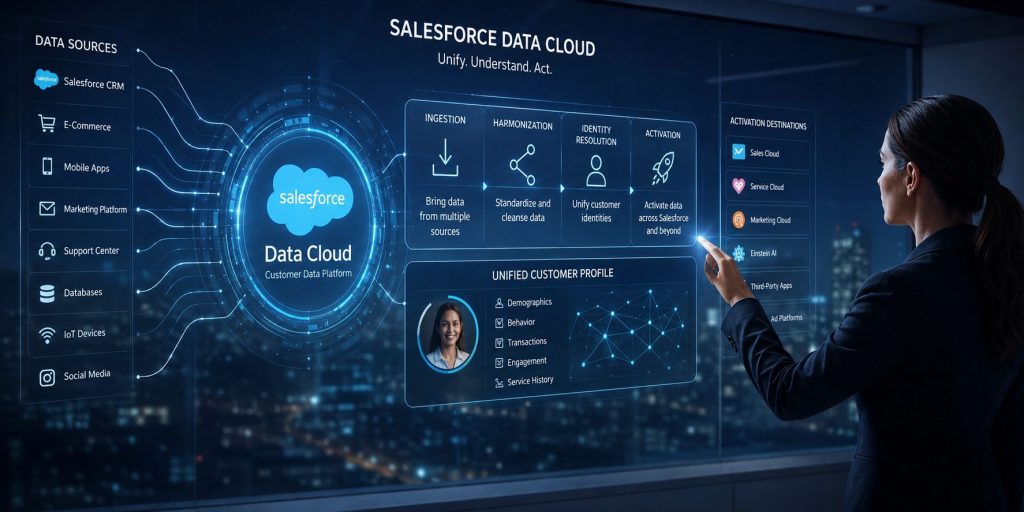
If you have been in Salesforce conversations lately, you have probably heard Salesforce Data Cloud come up a lot, usually with excitement and not always a clear explanation of what it actually does. It gets described as a customer data platform, a data lake, and an AI engine, depending on who you ask. All of those descriptions have some truth in them.
What Is Salesforce Data Cloud? (Salesforce CDP Explained)
Salesforce Data Cloud (officially rebranded as Data 360 in October 2025, though most people still use the original name Salesforce Data Cloud) is a customer data platform (CDP) that pulls customer data from multiple systems and connects it into one unified view of each customer.
In most organizations, customer information lives across several tools that were never designed to talk to each other. A customer buys something on your website. They open a support ticket. They respond to a marketing email. They talk to a sales rep. Each of those interactions lands in a different system, filed under a slightly different version of the same person’s name, email address, or account number.
Salesforce Data Cloud connects those records and builds a unified customer profile. When a sales rep opens a customer account in Salesforce, they can see the full customer journey in real time. That broader picture is what enables personalization, AI predictions, and cross-team coordination powered by Salesforce Data Cloud.
A Quick Note on Salesforce Data Cloud Rebranding
Salesforce officially rebranded Salesforce Data Cloud to Data 360 on October 14, 2025. The product and its capabilities remain the same. This article uses “Salesforce Data Cloud” throughout because it is still the most widely searched term and commonly used across Salesforce Trailhead and Salesforce Data Cloud documentation.
How Does Salesforce Data Cloud Work?
Understanding Salesforce Data Cloud architecture helps determine whether the platform fits your organization. There are four key stages in Salesforce Data Cloud implementation:
1. Data Ingestion (Salesforce Data Cloud Integration)
Data flows into Salesforce Data Cloud from multiple sources — Salesforce CRM, ecommerce platforms, mobile apps, call centers, marketing automation tools, and external databases. Salesforce provides pre-built connectors and API-based integrations for custom systems.
2. Harmonization (Salesforce Data Model Standardization)
Each system uses different structures and naming conventions. Salesforce Data Cloud maps everything into a common data model so that customer data from different systems becomes comparable and usable.
3. Identity Resolution (Unified Customer Profile in Salesforce Data Cloud)
This is one of the most powerful capabilities of Salesforce Data Cloud. It uses deterministic and probabilistic matching to determine whether different records belong to the same customer. The result is a unified customer profile powered by Salesforce Data Cloud identity resolution.
4. Activation (Salesforce Data Cloud Data Activation)
Once unified profiles are created, teams across the business can use them:
- Marketing Cloud journeys use real-time behavioral data
- Sales Cloud shows cross-channel customer history
- Service Cloud agents get full customer context
- Einstein AI models use richer data for better predictions
As of 2026, Salesforce Data Cloud also supports zero-copy architecture, allowing organizations to query data directly from Snowflake, Databricks, or Google BigQuery without moving it into Salesforce Data Cloud storage.
Is Salesforce Data Cloud the Same as a Customer Data Platform (CDP)?
A customer data platform (CDP) typically collects data from multiple sources, builds unified profiles, and activates those profiles for marketing use cases.
Salesforce Data Cloud does all of that — but it extends further across the entire Salesforce ecosystem.
With Salesforce Data Cloud:
- Service agents see unified customer data in real time
- Sales teams get behavioral insights from external systems
- Einstein AI improves predictions using cross-platform data
- Marketing personalization becomes real-time and event-driven
If your organization already uses a third-party CDP, Salesforce Data Cloud can often act as a consolidation layer, reducing integration complexity and improving data consistency.
Salesforce Data Cloud Pricing (2026 Overview)
There is a free tier. Salesforce announced at Dreamforce 2023 that organizations can access Salesforce Data Cloud for up to 10,000 unified profiles at no cost.
Salesforce Data Cloud Free Tier
- Up to 10,000 unified customer profiles
- Limited segmentation and activation
- Ideal for Salesforce Data Cloud proof of concept
Salesforce Data Cloud Starter (Paid)
The paid Salesforce Data Cloud Starter edition uses a consumption-based pricing model. Based on 2026 estimates, pricing typically starts around $500/month and scales based on:
- Data volume ingestion
- Number of unified profiles
- Activated use cases
Salesforce Data Cloud in Einstein 1
One important note: Salesforce Data Cloud is included in some enterprise bundles such as Einstein 1 Service ($500/user/month), which already includes Data Cloud capabilities.
| Tier | Profiles | Key Limitations | Best For |
|---|---|---|---|
| Freemium | Up to 10,000 | Limited activation and segmentation | Testing Salesforce Data Cloud |
| Data Cloud Starter | Scales with usage | Full Salesforce Data Cloud capabilities | Mid-market organizations |
| Einstein 1 Bundle | Included | Full capabilities included | Enterprise Salesforce users |
Benefits of Salesforce Data Cloud
Unified Customer Profiles Across Systems
Salesforce Data Cloud creates a single customer view by combining CRM, marketing, ecommerce, and service data.
Stronger AI with Einstein and Salesforce Data Cloud
AI models become more accurate when trained on unified data across multiple systems.
Real-Time Personalization
Salesforce Data Cloud enables real-time customer experiences across marketing, sales, and service channels.
Eliminates Data Silos
Breaks down fragmentation between departments and systems.
Do You Actually Need Salesforce Data Cloud?
This is the question most Salesforce Data Cloud articles avoid answering directly.
You Probably Need Salesforce Data Cloud If:
Your Customer Data Is Spread Across Multiple Systems
If your sales, marketing, and support teams all rely on different tools, you already have fragmented data — Salesforce Data Cloud solves this through customer data unification.
Your Salesforce AI (Einstein) Is Underperforming
Einstein models improve significantly when trained on unified data from Salesforce Data Cloud, including behavioral and transactional signals.
Your Teams Don’t Agree on “The Customer”
If different teams see different versions of the same customer, Salesforce Data Cloud helps create a single source of truth.
You Probably Don’t Need Salesforce Data Cloud Yet If:
You Operate Fully Inside Salesforce
If all customer interactions happen inside a clean Salesforce org, you may already have sufficient visibility without Salesforce Data Cloud.
Your Data Quality Issues Are Still Unresolved
Implementing Salesforce Data Cloud without fixing underlying data quality problems can amplify inconsistencies rather than solve them.
How Sarla Consulting Helps with Salesforce Data Cloud Implementation
At Sarla Consulting, our Salesforce Data Cloud consulting services include assessment, implementation, and ongoing managed support.
We work across healthcare, financial services, retail, manufacturing, nonprofits, and education.
Our Salesforce Data Cloud Services Include:
- Salesforce Data Cloud assessment and readiness analysis
- Salesforce Data Cloud implementation and integration
- Identity resolution setup and configuration
- Salesforce Data Cloud architecture design
- AI and Einstein enablement using Data Cloud
- Managed services and optimization
We always begin with a Salesforce Data Cloud assessment to understand:
- Where your data lives today
- How fragmented your customer view is
- Whether Salesforce Data Cloud is actually needed
If Salesforce Data Cloud is the right fit, we implement it. If not, we will say so – because poor Salesforce Data Cloud implementation without proper data foundation leads to fragmented systems rather than unified customer profiles.
If you are evaluating Salesforce Data Cloud implementation or consulting services, the first step is a free assessment to understand your current data landscape and whether Salesforce Data Cloud is the right solution.