
Most nonprofits know their programs are working. The problem is proving it.
At the same time, demand for that reporting is going up. Benevity’s 2026 research found that 42% of nonprofits have seen increased demand for custom impact reporting with specific data requirements since the start of 2025, and 49% report that their donors rarely fund the associated effort.
That gap is exactly the problem Salesforce Outcome Management is designed to close.
This article explains what Outcome Management actually does inside Agentforce Nonprofit.
What Is Outcome Management?
Salesforce Outcome Management is a module inside Agentforce Nonprofit. It is part of the same license, available alongside fundraising, program management, case management, and grantmaking.
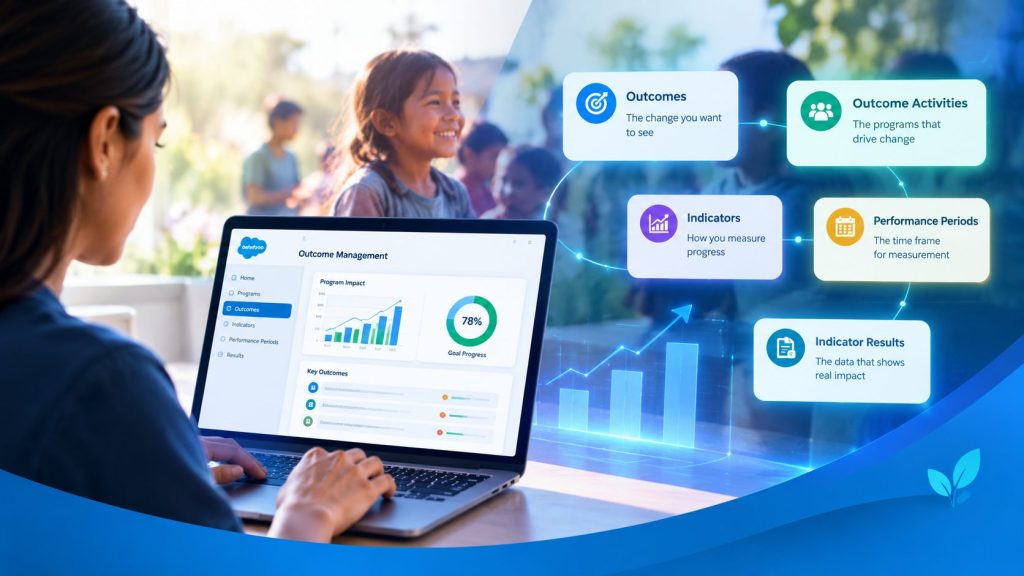
The module gives you a structured place to record:
- What your organization is trying to change in the world (outcomes)
- How you will know change is happening (indicators)
- What programs or services are driving that change (outcome activities)
- Over what timeframe you are measuring it (performance periods)
- What the actual numbers show (indicator results)
The goal is to connect your mission statement to measurable data and make that data available inside the same system your team already uses for program delivery.
Outcome Management stores structured data. Reporting on that data still requires Salesforce Reports, Tableau, or a third-party integration. Outcome Management gives you clean data to feed those tools.
The Five Building Blocks of Salesforce Outcome Management
Understanding how the module works requires knowing its core objects and how they connect to each other. They are actual records you create in Salesforce.
1. Outcomes
An outcome is a measurable change in a program participant or stakeholder. “We help people improve their financial health” is a mission statement. “Participants achieve a 15-point increase in their financial literacy assessment score within 90 days of program completion” is an outcome.
When you create an outcome record in Salesforce, you give it a name, a description, and a type. You can have multiple outcomes running simultaneously across multiple programs.
2. Outcome Activities
An outcome activity is the connection between an outcome and the program that is producing it. If you run a nutrition education program managed through Agentforce Nonprofit, you link that program to the outcome you expect it to generate. This connection is what tells the system: “this program is supposed to produce this change.”
This is one of the most common configuration mistakes wherein organizations set up outcomes and then do not link them to programs, so the data never flows.
3. Indicator Definitions and Indicator Assignments
An indicator is what you measure to determine whether an outcome is being achieved. Indicator definitions are the library of measurables your organization maintains.
A food security program, for example, might use “number of meals missed in the past week” as its indicator definition. It is a consistently defined measure that can be tracked from participant intake through program exit and reused across multiple program cycles without being redefined each time.
Indicator assignments connect a specific indicator definition to a specific outcome or program. This is where the distinction between outputs and outcomes matters most. If you assign “number of participants who attended training” to a program, that is an output indicator. It tells you how much activity happened.
4. Indicator Performance Periods
A performance period ties your indicator assignment to a specific timeframe with a starting point and an end goal. You set a baseline value (where participants begin) and a target value (where you expect them to be at the end of the period).
This is what converts outcome measurement from a static snapshot into a longitudinal view. Performance periods are reusable year to year, which means you can compare cohorts across funding cycles. That is significant for multi-year grant reporting.
5. Indicator Results
An indicator result is the actual data point recorded at a specific point in a performance period. You can enter these manually, import them from an external source, or set up a Salesforce Flow to create them automatically when a participant completes a milestone.
The automated approach is the right one for most organizations at scale, but it requires configuration. This is typically where a Salesforce consultant earns their value.
Where Dynamic Assessments and ARC Fit In
Dynamic Assessments
Dynamic Assessments is a companion feature that builds structured questionnaires inside Salesforce and stores the responses directly as indicator results. When you tie an assessment to a performance period, the data lands where it needs to be without manual transfer.
This is particularly useful for social service organizations doing case management, where participant progress is tracked through regular check-ins. Instead of entering assessment scores into a spreadsheet and then manually transferring them to Salesforce, the assessment lives in Salesforce, and the results stay there.
Dynamic Assessments require more configuration effort than the core Outcome Management objects. It runs on OmniScript and involves building assessment question sets, which is not something a non-technical admin should attempt without a guide or a consultant. But when it is set up correctly, the time savings are meaningful. With this, the data collection becomes a natural part of service delivery rather than a separate reporting task.
The Actionable Relationship Center (ARC)
The Actionable Relationship Center is a visual interface that shows how all your outcome management records connect to each other. Starting from an Impact Strategy, you can see the outcomes connected to it, the indicator assignments tied to those outcomes, the outcome activities linking programs to outcomes, and the performance periods tracking progress.
For a program director presenting to a board or a funder, ARC provides a real-time graphical view of how the organization’s programs connect to its stated impact goals. That kind of visibility changes conversations with funders from “trust us, it’s working” to “here is exactly what the data shows.”
The Four Mistakes Organizations Make When Setting Up Outcome Management
Salesforce Outcome Management is harder than expected to implement well. These are the four places where organizations consistently run into trouble.
1. Defining outcomes that cannot be measured
An outcome like “participants feel more confident” is a program aspiration. To work in Outcome Management, it needs an indicator someone can actually collect. If there is no data collection mechanism connected to the outcome, the performance period stays empty.
2. Skipping the Theory of Change step
Salesforce Outcome Management is a tool for executing an impact measurement strategy. Organizations that jump straight into creating records without first working through their Theory of Change end up with a collection of disconnected records that do not tell a coherent story.
The setup conversation should start with a whiteboard.
3. Not linking outcome activities to programs
As mentioned earlier, creating outcomes without linking them to programs through outcome activities is the most common configuration gap. The system has no way to know which program is supposed to produce which outcome unless you create that connection explicitly. When it is missing, the organization’s impact data sits in Salesforce disconnected from its program data, which is barely better than a spreadsheet.
4. Treating Outcome Management as a reporting function
The worst implementation pattern is when an organization goes live on Agentforce Nonprofit, runs programs for six months, and then tries to retroactively build outcome tracking to satisfy a grant report due in three weeks. The assessments were never taken.
Outcome Management works when it is built into program delivery from the start.
What This Looks Like in Practice
An organization runs a 12-week financial wellness program for adults experiencing housing instability. Participants go through an intake assessment, weekly sessions, and a structured exit where they leave with a personal financial plan.
Here is how Outcome Management structures that:
- Impact Strategy: Financial stability for housing-insecure adults in New York
- Outcome: Participants demonstrate improved financial literacy within 90 days of program completion
- Outcome Activity: Links the “Financial Wellness 12-Week Program” benefit to the above outcome
- Indicator Definition: Financial literacy assessment score (scored 0–100)
- Performance Period: January 1 to March 31, 2026. Baseline: 65. Target: 80.
- Indicator Results: Pulled automatically from Dynamic Assessment responses at intake and at the 12-week follow-up
At the end of the quarter, the program director pulls an ARC view and sees: 48 participants completed the program. The average intake score was 63. The average 12-week score was 81. 39 of 48 participants (81%) met or exceeded the target of 80.
The program director now has a grant compliance report ready to send and it took no Friday afternoon spreadsheet scramble to produce it.
Outcome Management and Agentforce AI
Agentforce Nonprofit now includes AI agents that work directly on top of Outcome Management data. A grant management agent monitors reporting deadlines and, when one is approaching, pulls the relevant indicator results and drafts the compliance document for a staff member to review. Program agents surface participants who have fallen below target values before the performance period closes.
These capabilities are available in the Agentforce Nonprofit license tiers that include Agentforce for Nonprofit Cloud. They require Data Cloud to be active for the more sophisticated AI-driven insights. Organizations that have Outcome Management set up correctly are in a position to benefit from these agents. Those who skipped it or configured it incorrectly will find the agents have nothing useful to work with.
This is a practical reason to treat Outcome Management setup as foundational infrastructure, not an optional feature.
Is Outcome Management Right for Your Organization?
Outcome Management in Agentforce Nonprofit is worth the setup effort if:
- You have one or more programs where participant-level data is collected
- You report outcomes to institutional funders (foundations, government grants, United Way)
- You are currently managing outcome data in spreadsheets or across disconnected systems
- You want to be able to demonstrate impact in real time
It is less immediately valuable if:
- Your organization is primarily membership or advocacy-based with no direct service participants
- You are still in early stages of building your measurement framework and do not yet know what you are trying to measure
For most direct-service nonprofits and social services organizations operating in the United States, Outcome Management is one of the highest-leverage features in the Agentforce Nonprofit suite — and one of the most underused, because organizations do not know it exists or are not sure how to start.
How Sarla Consulting Implements Outcome Management
At Sarla Consulting, our nonprofit implementations include an Outcome Management discovery session before any configuration begins. We work through the Theory of Change with program staff, identify the indicators that are both meaningful and practical to collect, map those to the programs and case management records already in Salesforce, and design the data collection flow so that indicator results are generated as a by-product of normal program delivery.
If your organization is running Agentforce Nonprofit and Outcome Management is not yet active or configured correctly, we can audit what is in place, identify the gaps, and build a configuration that your program team will actually use. Schedule a free consultation with our team to talk through what that would look like for your programs.