
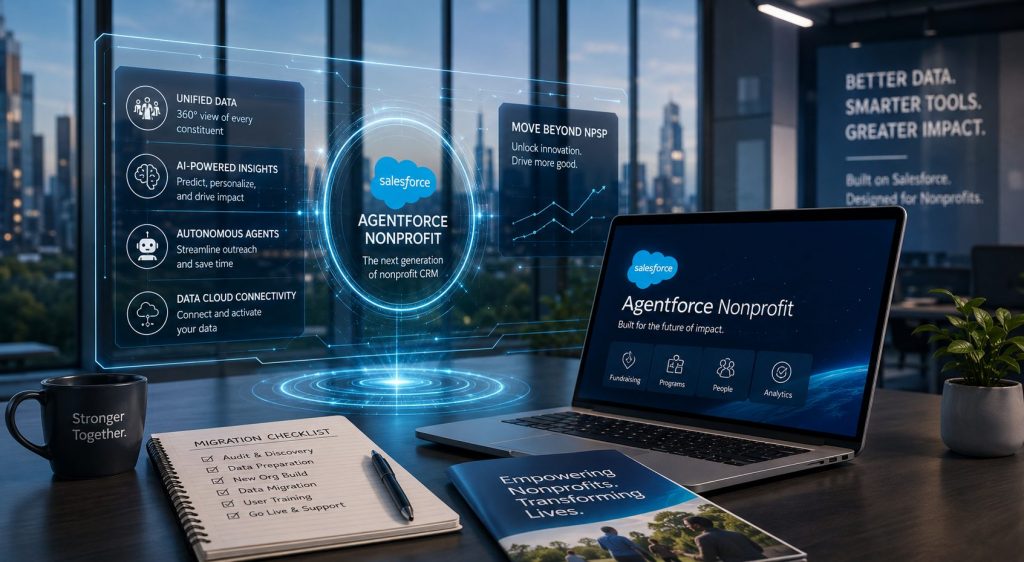
If your nonprofit runs on Salesforce’s Nonprofit Success Pack, your platform still runs, but you could be seriously lagging behind in a lot of aspects. This is because Salesforce stopped adding features to NPSP in March 2023. That was three years ago. Since December 2025, Salesforce has stopped offering NPSP licenses to new nonprofits entirely, pointing all new applicants to Agentforce Nonprofit instead.
Every innovation Salesforce is building for the nonprofit sector, AI-powered fundraising insights, autonomous agents that can draft donor outreach, Data Cloud connectivity, and next-generation program management, is being built on Agentforc nonprofit.
This guide covers what the migration actually involves, what changes (and what doesn’t), the risks that catch organizations off guard, and how to think about the timing decision without panic or pressure from a vendor.
What Is Agentforce Nonprofit and Why Did Salesforce Build It?
NPSP was built as a managed package, a set of tools installed on top of the standard Salesforce Sales Cloud to make it work for nonprofits. It added household account structures, donation tracking, recurring gifts, soft credits, and relationship management. For over a decade, it served the sector well and was the default path through Salesforce’s Power of Us Program.
The problem with that architecture was always structural. A managed package sits on top of the platform rather than inside it. That means slower access to Salesforce’s core innovations, greater complexity in upgrades, and a growing gap between what NPSP could do and what Salesforce’s core platform could. Every new feature Salesforce built for Sales Cloud required additional work to reach NPSP users. Every Salesforce update carried some risk of breaking something in the package layer.
In 2023, Salesforce decided to stop building industry solutions as packages and instead unified all its industry clouds, including nonprofit, healthcare, financial services, and manufacturing, into the core Salesforce platform under a shared data model. The result for nonprofits was Nonprofit Cloud, rebranded as Agentforce Nonprofit in October 2025.
Agentforce is not a name change. According to Salesforce Ben’s 2026 state of nonprofit offerings report, Agentforce represents Salesforce’s broader push to embed AI agents directly into workflows. For nonprofits, that means
- Einstein-powered predictions
- Autonomous agents that can assist with donor outreach
- Grant reporting drafts and case management
- Direct access to Data Cloud for connecting constituent data across systems.
The Honest State of NPSP in 2026
Before getting into the migration itself, here’s the accurate picture of where NPSP stands, because there’s a lot of noise in the sector and some of it overstates the urgency.
What is true:
- Salesforce removed NPSP from the Power of Us Program in December 2025. New nonprofits applying for donated licenses now receive 10 free Agentforce Nonprofit licenses instead.
- Salesforce has not announced an end-of-life date for NPSP. Existing users retain their licenses. There is no forced migration deadline.
- NPSP is open-source, which means even if Salesforce were to retire it, the packages would technically still be installable. But who would maintain them is a different question.
What is also true:
- The gap between what NPSP can do and what Agentforce Nonprofit can do gets wider with every Salesforce release.
- AI capabilities, including Agentforce autonomous agents and Einstein predictions, are not accessible from NPSP. This is an architectural limit.
- Over 56,000 nonprofits currently use Salesforce. The majority of them are still on NPSP. That means the pressure to migrate will build over the next two to three years, whether or not Salesforce forces anyone’s hand.
It is pretty obvious that if you’re regularly asking for functionality that requires third-party workarounds, or if AI-driven donor engagement is on your roadmap, the case for moving gets stronger.
The Core Differences Between NPSP and Agentforce Nonprofit
This is where most nonprofits underestimate the scope of what they’re considering. NPSP and Agentforce Nonprofit are architecturally different, and those differences affect nearly every part of how your team works in Salesforce.
| NPSP | Agentforce Nonprofit | |
| Architecture | Managed package on top of Sales Cloud | Natively built into the Salesforce platform |
| Constituent model | Household Accounts + Contacts | Person Accounts (unified individual record) |
| Donation tracking | Opportunities for all gift types | Gift Transactions / Gift Commitments / Opportunities |
| New features | Ended March 2023 | Active, with every Salesforce release |
| AI / Agentforce agents | Not accessible | Built in natively |
| Data Cloud connectivity | Not available | Native integration |
| AppExchange ecosystem | Mature, stable | Growing rapidly, most major tools are now supported |
| Power of Us free licenses | No longer offered to new orgs | 10 free licenses for new applicants |
| Migration path | N/A (source) | Full re-implementation required from NPSP |
The data model change is the biggest issue
Agentforce Nonprofit uses Person Accounts. Each constituent becomes a unified Account-Contact object. The individual is at the center of the process. Household relationships are handled through the Party Model, a more flexible structure that allows groups and relationships without the constraints of the old household account setup.
How donation tracking changes
In NPSP, everything related to money goes into Salesforce as an Opportunity record. That single object approach was familiar and workable, even if it blurred some important distinctions.
Agentforce Nonprofit splits this into three objects:
- Gift Transactions: one-time donations
- Gift Commitments: pledges and recurring gifts
- Opportunities: cultivation and solicitation activity
Existing NPSP donation data does not map one-to-one. Every Opportunity record has to be assessed and routed to the appropriate object in the new model. For organizations with years of gift history, this is one of the most labor-intensive parts of the migration.
Your automations and integrations need to be rebuilt
If you have Process Builders, Flows, Apex code, or third-party integrations built around the NPSP data model, they will not work as-is in Agentforce Nonprofit. The objects they reference have changed. For example, a nonprofit using Classy for online donations had to rebuild its integration entirely to map to Gift Transactions and Person Accounts after migrating. That is the norm for any organization with custom integrations.
Signs Your Organization Is Ready to Move
Here are the indicators that the timing is right for your organization, drawn from RSM’s NPSP vs Agentforce Nonprofit comparison and real-world migration experience:
- Your system breaks when you try to grow it. If adding a new program, department, or fundraising campaign regularly requires expensive custom development or introduces risk to existing automations, the technical debt in your NPSP instance has compounded past the point where maintaining it makes sense.
- Your data is fragmented across your org. Fundraising data and program data live in different places. Your team exports to spreadsheets to do basic reporting. You can’t get a single view of a constituent’s full relationship with your organization without manual work.
- You want AI tools that actually do something. You need tools that can predict donor lapse, draft personalized outreach at scale, automating grant reporting summaries.
- Your AppExchange stack is straining. You’re using multiple third-party tools to fill gaps that Agentforce Nonprofit handles natively. Each additional tool adds cost, maintenance overhead, and data sync risk.
- You’re planning a major system overhaul anyway. A database cleanup project, a new major gifts program, a rebrand, or significant staff turnover creates a natural window for migration without adding disruption on top of normal operations.
What the Migration Actually Involves
This is where organizations get surprised. They hear ‘migration’ and think data transfer. What they’re actually doing is a full re-implementation with data migration layered on top. There is no push-button path from NPSP to Agentforce Nonprofit. Salesforce does not provide an automated tool that converts your org.
A structured migration involves these phases:
1. Discovery and org audit
Before any migration work begins, you need a detailed picture of what you currently have. That means documenting every custom object, custom field, automation, third-party integration, and AppExchange package in your NPSP org. This step is often underestimated and under-resourced, and it’s where migration projects that stall usually find their root cause.
At a minimum, your audit should cover:
- All NPSP-specific objects and how they map to Agentforce Nonprofit equivalents
- Every automation (Process Builder, Flow, Apex trigger), and whether it needs to be rebuilt or replaced
- Third-party integrations and their compatibility status with Agentforce Nonprofit
- Data quality: duplicates, incomplete records, inconsistent formatting in fields that will be migrated
- Picklists, record types, and custom fields that can be audited and trimmed before migration (this reduces scope and risk)
2. Data preparation
Data is the highest-risk part of the migration. Organizations should promote data standardization. Cleaning data in NPSP before migrating is far less expensive than cleaning it after.
Practically, this means:
- Deduplicating contact and account records
- Standardizing phone number formats, address formats, and naming conventions
- Reviewing all Opportunity records and categorizing them into the three Agentforce Nonprofit gift objects they’ll map to
- Keeping a crosswalk of old record IDs to new ones for post-migration validation
3. New org build
Agentforce Nonprofit is not built on top of your existing org. You build a new org configured to Agentforce Nonprofit’s architecture, then migrate data into it. This means your program management structure, fundraising configuration, security model, page layouts, and automations all need to be rebuilt from scratch in the new environment.
This is where an experienced implementation partner with specific Agentforce Nonprofit expertise makes the most meaningful difference. The configuration decisions made here determine how well the system serves your team for the next five to ten years.
4. Data migration and validation
The actual data move happens after the new org is built and tested. Data is extracted from NPSP, transformed to match Agentforce Nonprofit’s data model (the ETL process: extract, transform, load), and loaded into the new org. Every record has to be validated after loading.
5. User training and go-live
One of the few reassurances in this process is that the Salesforce Lightning Experience interface remains consistent. Our Sral experts have witnessed that the day-to-day users will find minimal disruption to the interface, which helps with staff adoption. But the workflows are different. Training needs to happen before go-live, and you need a support plan for the weeks immediately after.
Change management is not optional here. This is the phase that determines whether your team ends up using the new system the way it was designed or reverts to spreadsheets because the transition wasn’t supported properly. Sarla Consulting’s change management service specifically addresses this by training leadership first, then cascading that knowledge through teams with hands-on support during the transition period.
How Long Does It Take and What Does It Cost?
Timeline and cost depend heavily on the size and complexity of your current NPSP implementation.
- Small nonprofits with clean data and straightforward configurations: two to three months for the full migration.
- Mid-sized organizations with custom objects, multiple integrations, and years of gift history: four to six months is realistic.
- Large organizations with complex customizations, multiple departments, and high data volumes: six to twelve months, sometimes longer.
On cost: Agentforce Nonprofit licensing for organizations beyond the initial 10 free Power of Us licenses starts at $60 per user per month for the Enterprise Edition, with AI-powered editions reaching up to $300 per user per month, as per experts. That’s the licensing cost. Implementation cost is separate and varies based on scope, partner, and whether significant data cleanup is needed before migration starts.
What to Do Right Now If You’re on NPSP
You don’t have to decide to migrate today. But there are things you can do right now that either prepare you for a smoother migration or help you make a more informed decision about timing.
Start the audit
The single most valuable thing any NPSP-running nonprofit can do today is understand the current state of their org. Document your customizations, automations, integrations, and data quality. Even if you don’t migrate for two years, this knowledge makes your NPSP instance easier to maintain and your eventual migration cheaper and less risky.
Clean your data now
Data cleanup before migration is always cheaper than cleanup after migration. If you have duplicate records, inconsistent formatting, or fields that haven’t been used in three years, address them in your current system. Good data governance practice benefits you regardless of when or whether you migrate.
Review your integration stack
Check whether your third-party tools, payment processors, event management platforms, and marketing automation tools have released native Agentforce Nonprofit integrations. Many AppExchange partners have already updated their solutions. Knowing your integration compatibility status gives you an accurate picture of the rebuild scope before you commit to a migration timeline.
Have the internal conversation about AI
Agentforce Nonprofit’s main value proposition, beyond a cleaner data model, is AI access. Before deciding on timing, your leadership team should discuss honestly whether autonomous AI agents for donor communication, Einstein-powered gift predictions, or Data Cloud analytics are on your roadmap in the next one to three years. If the answer is yes, every quarter you wait is a quarter that the gap widens.
Why Partner Selection Is a Critical Success Factor
The combination of data model transformation, new org build, ETL scripting, and change management requires expertise that takes years to develop, specifically in Agentforce Nonprofit.
At Sarla Consulting, our nonprofit Salesforce work covers the full spectrum: Nonprofit Cloud implementation, data migration, ongoing managed services post-go-live, and change management to make sure your team actually uses the new system the way it was designed. We’ve spent 20 years building Salesforce implementations that work for the organizations running on them, not implementations that look good in a demo and create problems six months later.
When you’re evaluating partners, ask specifically about their Agentforce Nonprofit migration experience, the number of migrations they’ve completed, and whether they can show you examples of post-migration validation processes. A partner who can’t answer those questions in detail hasn’t done enough of them.
Ready to Understand What Migration Would Actually Take?
If you’re on NPSP and trying to make a smart decision about whether and when to move to Agentforce Nonprofit, the right first step is an honest assessment of where your current org stands.
Sarla Consulting offers a free consultation to walk through your current NPSP configuration, identify your data quality situation, review your integrations, and give you a realistic picture of what a migration would involve for your specific organization. No pressure to commit. Just a clear, informed starting point.
Contact us to schedule your assessment.