
Automation is widely viewed as the ultimate solution to operational inefficiency, manual processes, and workflow complexity. Organizations invest heavily in workflow automation tools, system integrations, and digital transformation initiatives with the expectation that technology will remove friction from everyday work.
The underlying idea is straightforward: machines handle repetitive tasks so humans can focus on strategic and creative responsibilities.
Yet despite massive investment in business process automation, many initiatives fall short of expectations. One of the most common reasons is the decision to restrict automation design and control to a small group of administrators or IT specialists.
This admin-only automation model, often implemented in the name of security and governance, creates a centralized system that fundamentally contradicts the purpose of automation itself. Instead of enabling agility, scalability, and operational efficiency, it introduces bottlenecks, reduces participation, and erodes trust in automated systems.
This article explores why centralized automation fails and why democratized automation with governance is the future of scalable digital operations.
Understanding the True Nature of Workflow Automation
Workflow automation involves transferring repetitive, rule-based tasks from humans to systems. It is designed to streamline business processes, improve productivity, and scale operations efficiently. When implemented correctly, automation becomes a tool for continuous process improvement.
In modern organizations, processes constantly evolve due to market changes, compliance requirements, and organizational growth. Automation systems must therefore be flexible, adaptable, and aligned with real operational needs.
The most effective enterprise automation strategies allow the people who understand a process best to directly influence how it is automated.
Admin-only automation disrupts this alignment by separating process ownership from automation execution. Instead of enabling teams to optimize their own workflows, it forces them to rely on intermediaries who may not fully understand the nuances of each operation.
Technical Reasons Admin-Only Automation Fails
1. Workflow Bottlenecks and IT Backlogs
When automation is centralized, administrators become the sole channel for all automation requests. What starts as manageable quickly becomes an overwhelming backlog. Even small workflow changes can take weeks, eliminating the speed advantage automation is meant to provide.
2. Lack of Scalability in Enterprise Automation
As organizations grow, so does the demand for process automation. A small IT or admin team cannot continuously update workflows across an entire enterprise. This leads to partial automation, where only high-priority processes are addressed.
3. Missing Operational Context
IT teams often lack the detailed, day-to-day knowledge required for department-specific workflow automation. Finance, marketing, HR, and supply chain processes contain subtle exceptions that are difficult to capture without hands-on experience. The result is automation that works in theory but fails in practice.
4. Rigid, One-Size-Fits-All Workflows
To manage demand, admins rely on templates and standardized builds. While efficient, these rarely match the unique needs of each department. Employees then create manual workarounds, defeating the purpose of business process automation.
Organizational Impact of Centralized Automation
Admin-only automation doesn’t just create technical issues — it reshapes company culture and workflow ownership.
-
Teams lose autonomy over process improvement
-
IT departments become constant bottlenecks
-
Skilled administrators are pulled away from cybersecurity, system architecture, and innovation
-
Frustrated employees turn to shadow IT solutions
Shadow IT introduces major data security, compliance, and governance risks. When employees adopt unapproved tools to automate tasks, organizations lose visibility and control over their data.
User adoption also drops. When automation feels inaccessible, employees revert to manual processes, reducing the ROI of digital transformation investments.
Cultural Barriers Created by Admin-Only Automation
Centralized automation sends a message: automation is restricted. This discourages employees from experimenting or suggesting improvements.
It also reinforces silos between IT and business teams, turning collaboration into a ticketing process instead of a partnership.
Most importantly, admin-only models suppress innovation and continuous improvement. When every workflow update requires formal approval and technical intervention, employees stop trying to improve processes.
The Hidden Costs of Admin-Controlled Automation
The long-term costs of centralized automation often outweigh the initial investment:
-
Slower operations and delayed workflows
-
Higher IT workload and operational expenses
-
Increased security risks from shadow IT
-
Lower employee morale and engagement
-
Reduced return on automation tools
These hidden inefficiencies accumulate, undermining enterprise automation strategies.
The Shift Toward Democratized Automation
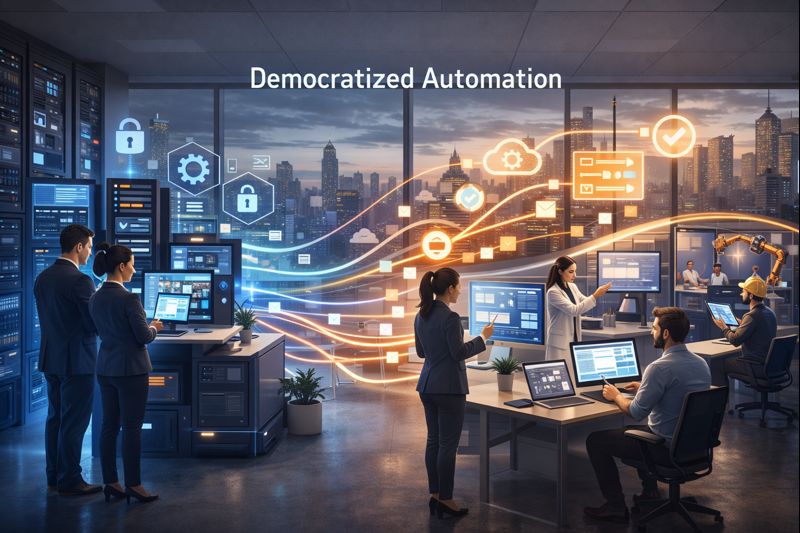
Forward-thinking organizations are moving toward democratized automation powered by low-code and no-code platforms. These tools allow non-technical users to build workflows visually while IT maintains governance.
In this model:
-
IT becomes an automation enabler, not a gatekeeper
-
Business teams gain ownership of their workflows
-
Citizen developers expand automation across departments
-
Governance frameworks ensure compliance and security
This approach increases automation scalability without increasing risk.
Governance Without Bottlenecks
Democratized automation does not mean uncontrolled automation. Modern platforms provide:
-
Role-based access controls
-
Workflow approval systems
-
Automated monitoring and audit trails
-
Version control and change tracking
These features support secure workflow automation while enabling rapid innovation.
Best Practices for Sustainable Workflow Automation
To build a scalable automation culture:
✔ Implement role-based access control
✔ Establish clear automation governance frameworks
✔ Invest in citizen developer training
✔ Maintain strong documentation and audit trails
✔ Encourage continuous feedback and process optimization
Treat automation as an evolving organizational capability — not a centralized IT service.
Conclusion: The Future of Automation Is Enablement
Admin-only automation fails because it centralizes control, limits scalability, and disconnects automation from real business needs. While designed to maintain governance, it often creates inefficiency and risk.
Organizations that succeed embrace democratized automation with strong governance frameworks. By empowering employees to improve their own workflows within secure environments, automation becomes a driver of innovation, agility, and operational excellence.
About Sarla Consulting
Sarla Consulting is a trusted IT solutions partner with over 20 years of experience in CRM development, Salesforce integration, and workforce automation. We help organizations simplify technology, streamline processes, and drive measurable growth through scalable, end-to-end digital transformation solutions. With deep expertise across industries like retail, healthcare, education, and manufacturing, our team combines technical excellence with a customer-first approach to make IT easy and impactful.