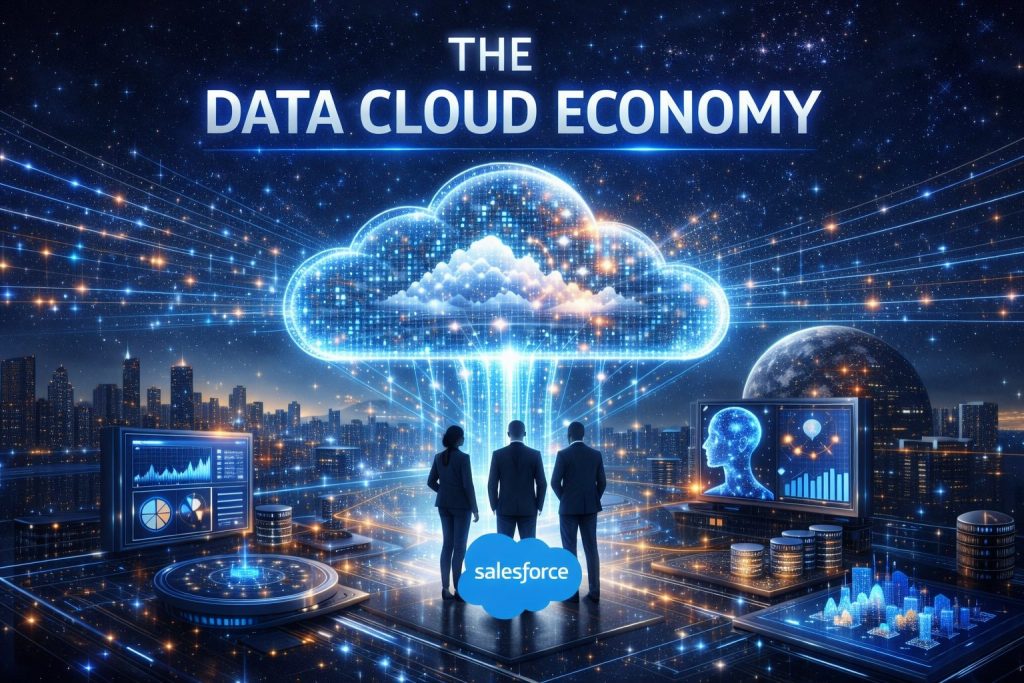
The global shift toward real-time, AI-driven business has pushed data to the center of every competitive advantage. Companies today generate information at an unprecedented scale. But raw data alone no longer creates value. The organizations that win are the ones that can understand and activate that data instantly. This is the foundation of the emerging Data Cloud economy, and Salesforce is positioning itself at the heart of it.
Understanding The Data Cloud Economy
The Data Cloud economy represents a move away from isolated databases and slow, batch-based processes toward interconnected, continuously updating information ecosystems. Modern businesses no longer operate in one system—they operate across dozens. Customer interactions happen in unpredictable ways and across a range of platforms, leaving information scattered and inconsistent. In this new economy, real-time connectivity becomes a basic requirement.
Cloud-native architectures have evolved to support this shift. Instead of copying data from system to system, businesses now rely on federated access and zero-copy integrations that reduce redundancy. The Data Cloud economy also brings a heightened focus on governance. Regulations like GDPR, HIPAA, and regional data protection laws require organizations to track lineage and avoid unnecessary data movement. Unified data platforms help businesses meet these demands while enabling intelligence at scale.
Salesforce’s Evolving Role
Historically, Salesforce was seen primarily as a CRM—an application for managing customer relationships and workflows. But the modern Salesforce ecosystem extends far beyond CRM. With Customer 360 and the rise of Salesforce Data Cloud, the platform now serves as a central infrastructure layer for customer data. It is designed to unify structured information from CRM and unstructured data across digital interactions.
Salesforce’s alignment with industry-standard cloud ecosystems, especially Snowflake and major data lakes, has strengthened its presence in enterprise data strategy. Data Cloud acts as the bridge between Salesforce applications and broader enterprise datasets, which offers a single platform where organizations can standardize identities and use AI without creating yet another silo.
Core Capabilities Of Salesforce Data Cloud
At the center of Data Cloud is real-time data ingestion. It pulls information from POS systems, marketing platforms, ERP records, and even IoT devices, harmonizing it into a unified model. Identity resolution stitches fragmented data across sources—matching email clicks to CRM contacts, store purchases to loyalty IDs, or mobile behavior to service cases.
Zero-copy integrations are one of the most valuable features. They allow Salesforce to access enterprise data stored elsewhere without physically moving or replicating it.
Eliminating Data Silos Across the Enterprise
Every organization struggles with fragmented data. Salesforce Data Cloud eliminates this fragmentation by creating a single customer profile that updates in real time. Instead of using snapshots captured hours or days earlier, businesses work with a continuously updated view of every interaction. This eliminates the operational delays common in batch-based systems and ensures that personalization, analytics, and AI are grounded in current information.
Real-Time Intelligence And AI Integration
Unified data becomes exponentially more valuable when paired with AI. Salesforce Einstein and other AI capabilities depend on high-quality, current information to produce accurate predictions. With Data Cloud, AI models improve because they can evaluate every product interaction as it happens.
This enables predictive scoring for leads, proactive retention strategies for high-risk customers, and dynamic experiences that adapt to a customer’s context in the moment. AI-generated next-best actions—whether in sales, service, or commerce—become far more precise when powered by real-time data streams rather than outdated records.
The Importance of Zero-Copy Architecture
In the Data Cloud economy, copying data creates risk. Every duplicate introduces a new attack surface, another compliance concern, and another version that must be kept in sync. Zero-copy architecture solves these challenges by allowing analytics, AI, and apps to use enterprise data in place—without replication.
For regulated industries, this approach reduces exposure significantly. Data remains governed where it resides, while Salesforce accesses it securely and compliantly. Zero-copy design also reduces storage and integration costs, making data activation more efficient.