
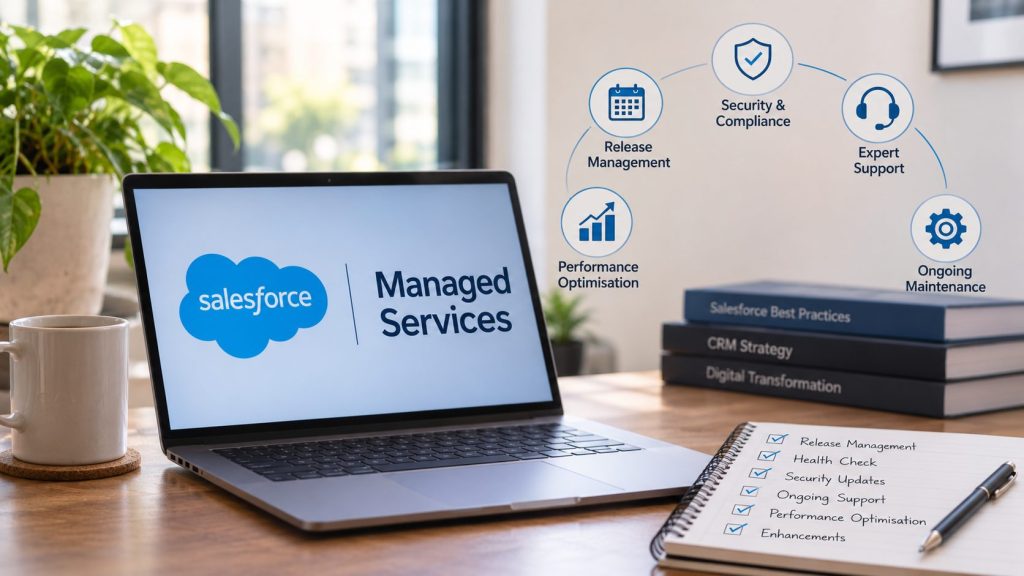
Salesforce managed services involve much more than resolving support tickets or handling occasional system updates. They encompass the continuous management, maintenance, security, and optimisation of a Salesforce environment to ensure the platform remains reliable, efficient, and aligned with changing business requirements. Even after a Salesforce implementation goes live, the work continues through regular platform updates, seasonal release management, security reviews, performance monitoring, user support, and ongoing system improvements. These responsibilities are essential to keeping a Salesforce org functional, secure, and up to date with Salesforce’s evolving platform standards. For businesses, understanding what Salesforce managed services actually include is important when deciding the level of ongoing support, technical expertise, and strategic oversight their CRM environment requires.
Sarla’s own guide to Salesforce data migration and Health Cloud implementation guide cover that project-phase work. Managed services picks up everything that happens after those projects ship.
The Maintenance Work Salesforce Already Documents
Salesforce ships three major releases a year, and its own release-readiness guidance tells admins to pull a preview sandbox and test new features against real workflows before the release reaches production (Salesforce Admins). The guidance exists because a release can change a default setting that an old automation quietly depends on.
Salesforce also builds a security scoring tool directly into Setup. Health Check compares an org’s actual settings against Salesforce’s own recommended baseline and returns a score from 0 to 100. Multi-factor authentication is one of the settings it checks: if MFA isn’t enforced org-wide, Health Check flags the gap and links straight to the fix (Trailhead).
Alongside Health Check, Salesforce’s Optimizer tool scans an org for configuration nobody uses anymore. Unused permission sets left behind after a project wraps up are a common find, and Optimizer flags them for cleanup (Salesforce Ben). For organizations running more than one org, Salesforce’s Security Center add-on extends Health Check across all of them and reports on multi-factor authentication adoption org by org (Trailhead).
What Happens When Nobody Owns This Calendar
Salesforce Ben’s 2026 admin survey found that 43% of respondents work on teams with no developer support at all, and 20% are the only Salesforce person in their organization (Salesforce Ben). This ratio gets tighter at smaller companies: 70% of organizations with 50 to 199 employees run on an admin-only team, covering everything from day-to-day support tickets to the maintenance calendar above with the same one or two people.
The same survey found that only 2% of admins describe their org as clean and well maintained, and 31% report technical debt high enough to regularly slow down new work. Over 60% of orgs are more than five years old, and a quarter have passed the ten-year mark, which is a long stretch for one person’s undocumented decisions to pile up (Salesforce Ben).
Salesforce Ben has a name for the risk this creates: bus factor, the number of people who could leave before a project stalls. Its research found that 19.47% of admins are a team of one, meaning the reasoning behind old configuration choices exists only in that person’s head, with no documentation and no backup admin to ask (Salesforce Ben).
What Does a Salesforce Managed Services Provider Do?
If your in-house Salesforce administrator is spending valuable time managing routine platform updates and maintenance, Salesforce managed services can take these responsibilities off their plate. A managed services provider offers ongoing Salesforce administration and support, ensuring that critical platform maintenance is handled consistently rather than becoming an occasional task. Before each of Salesforce’s three annual releases reaches production, a dedicated expert reviews the preview sandbox, identifies potential compatibility issues, and flags changes to default settings that could affect existing configurations. This proactive Salesforce release management process helps organisations prepare for platform updates while minimising disruption to daily operations.
As part of ongoing Salesforce maintenance services, the provider also runs Salesforce Health Check assessments on a scheduled basis, identifies security gaps, and works towards aligning the organisation’s security score with Salesforce’s recommended baseline. These assessments help maintain essential security practices and ensure the Salesforce environment follows recommended configuration standards. The provider also conducts regular Salesforce Optimizer reviews to identify unused features, redundant customisations, and outdated configurations. Removing unnecessary components helps improve Salesforce org performance, simplify administration, and prevent technical debt from accumulating as the business grows.
Alongside scheduled maintenance, a Salesforce managed services provider handles day-to-day support requests from employees who need technical assistance with their workflows, automation, or CRM processes. This includes troubleshooting issues, resolving user queries, managing configuration changes, and providing ongoing Salesforce technical support to keep business operations running smoothly.
Beyond routine support and maintenance, most managed services agreements also allocate a fixed number of hours each month for Salesforce enhancements. These improvements are aligned with the organisation’s immediate business priorities and are typically planned during short quarterly review sessions. This allows businesses to continuously improve their Salesforce environment without having to initiate a separate project for every configuration change or minor enhancement.
Another important advantage of outsourced Salesforce administration is shared technical knowledge. Since the responsibility is distributed across a provider’s team rather than resting with a single administrator, multiple experts understand the organisation’s configurations, workflows, and automation. This reduces dependency on one individual, improves continuity, and minimises the risks associated with the loss of internal technical knowledge.
However, work that extends beyond maintaining and improving the existing Salesforce environment, such as building a new integration with an external system or implementing a major new functionality, is generally scoped as a separate project. This distinction helps businesses understand what is covered by their monthly Salesforce managed services contract and what requires additional development resources or project-based investment.
How to Evaluate a Salesforce Managed Services Provider
The practical test for a Salesforce managed services provider is whether the release-and-security calendar above shows up as a repeated part of the contract. Ask how many people on the provider’s side could answer a question about the org tomorrow if the main point of contact left; that answer tells you whether the provider actually fixes the bus-factor problem or just relocates it.
Sarla Consulting, based in Woodbury, New York, builds its managed services engagements around that calendar for clients across the US, testing every release in sandbox first and keeping more than one named admin on every account. Work that outgrows the retainer, a full re-platform or a new build, moves to Sarla’s Salesforce implementation team instead.
A short conversation is usually enough to map that calendar against a specific org and show where the gaps are. Book a free consultation with Sarla.