
In July 2026, the New York Public Service Commission fined five utility companies a combined $50.1 million for missing their 2025 customer service targets. The misses were plain and measurable. Some failed on call answer rate. Others failed customer satisfaction surveys.
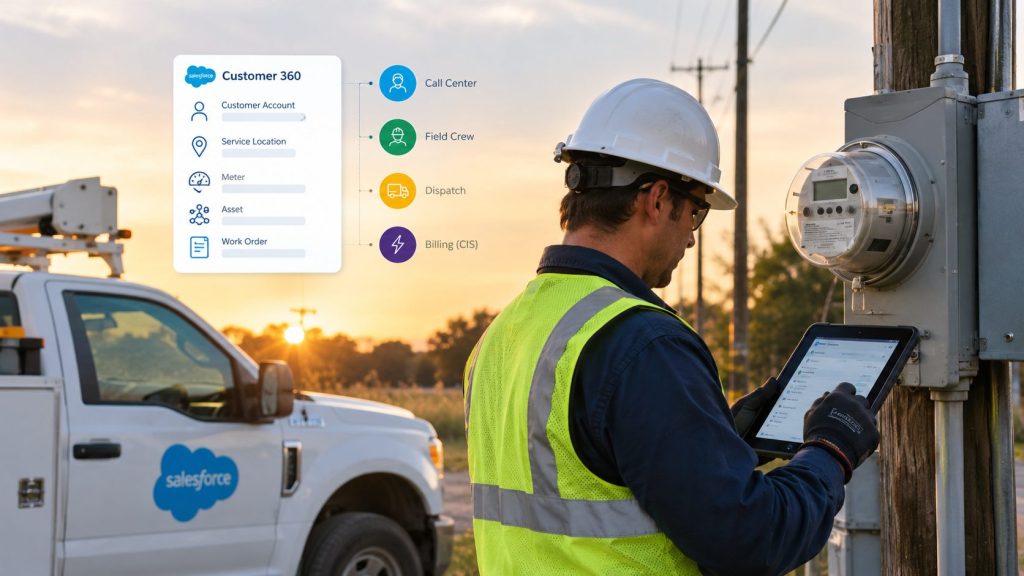
Behind many such missed targets is an agent who can’t answer the one question, ‘when is the crew coming?’ In most organizations, the crew’s status sits in a work management tool while the account and the bill sit in the CIS. The agent has to keep switching between screens that rarely agree.
That gap is the utility data silos problem, and Salesforce Energy and Utilities Cloud is built to close it.
What is Salesforce Energy and Utilities Cloud?
Salesforce Energy and Utilities Cloud is energy CRM software, a version of Salesforce built for energy and water utilities. Salesforce now markets it as Agentforce Energy & Utilities, and both names point to the same product. Its training content on Trailhead uses the newer name.
Under the hood, Salesforce describes the product as four layers stacked together:
- The core Salesforce platform, with its security and reporting tools
- Data 360 (formerly Data Cloud), which brings asset and work data together with customer records
- Prebuilt utility processes, such as grid connection requests and schedule-and-dispatch
- AI agents for customer service, energy advice, operations and the mobile workforce
The part that matters most for this article is the shared data model. A customer, the service location they live at, the meter on the wall, and the transformer up the street can all be linked records. Once they are linked, a work order raised against that transformer knows exactly which customers it affects.
Utility billing system integration
Most utilities already run billing on a dedicated CIS, and that system stays in place. That is why Salesforce integration for utility companies usually starts with the billing connection. Salesforce says the product ships with prebuilt connections to the major utility billing and CIS platforms, with MuleSoft available for anything custom. The CIS keeps doing billing. Salesforce becomes the place where people actually work with the customer, which gives utilities a path to legacy system modernization without a risky billing replacement.
How field work and customer records end up on one platform
Here is how responsibility usually splits inside a utility today, and what changes when Salesforce sits across it.
| Area | Where it usually lives today | What Salesforce adds |
| Customer account and bill | CIS / billing system | A single customer view for agents, with billing data pulled in through prebuilt connections |
| Physical assets (meters, transformers) | Asset registry or GIS | Utility asset tracking, with each asset linked to customers and service locations |
| Field work orders | Work management or dispatch tool | Crew scheduling and an offline mobile app on the same platform |
| Outage and incident updates | Outage system, phone scripts | Agents and customers see incident status tied to the affected accounts |
| Program enrollment (rebates, solar, EV) | Separate portals or paper applications | Online enrollment and eligibility checks on the customer record |
The value comes from the links between rows. A dispatcher who reschedules a crew changes the date the call center agent sees right away, with no email chain in between.
Salesforce Field Service for utilities
Salesforce Field Service for utilities is field service management software for utilities. It covers the work that happens between “we need someone on site” and “job closed.” Its scheduling engine plans routes to cut travel time, and the dispatcher console matches each job to a technician with the right skills. Salesforce also ships preconfigured workflows for electric and gas field work.
For crews, it works as utility field workforce management software, and the mobile app is built offline-first. Crews keep working and saving changes with no signal, which matters a lot more for a lineworker in a rural county than for a sales rep in an office park.
Most of the time goes into scheduling. In its Agentforce for Field Service announcement, Salesforce reported research showing that inefficient scheduling is the biggest time drain on field service teams. Its survey found it takes an average of 17 minutes to schedule an appointment and 15 minutes to change one. The same research found skilled technicians lose nearly an entire workday each week to admin.
The Agentforce layer brings field service automation for energy companies to that admin load. Agents can book appointments through web chat or messaging, brief a technician on the job before arrival, help troubleshoot on site using photos and past records, and draft the job wrap-up note afterward.
The Sarla Consulting experts advise setting up scheduling rules and crew skills before you switch on the AI features. The agents work far better on top of clean scheduling data.
Utility asset management
Utilities carry a lot of old equipment. A US Department of Energy Grid Deployment Office briefing noted that 70% of transmission lines and power transformers are more than 25 years old. At the same time, Deloitte’s 2026 power and utilities outlook projects US peak demand will grow about 26% by 2035, and puts the sector’s capital needs at more than $1.4 trillion through 2030.
Older equipment carrying more load means more failures unless maintenance gets ahead of them. Salesforce works as asset management software for energy companies here. The product page says teams can track assets in real time and automate predictive maintenance, and it supports that shift in two ways.
First, maintenance plans can run on condition as well as the calendar. Salesforce says teams can build preventive maintenance plans around how an asset is used or its condition, such as a temperature reading crossing a threshold. When that happens, a work order is created and lands in the dispatcher’s queue.
Second, Data 360 adds AI predictive maintenance for utilities on top of the asset records. Salesforce lists ready-made data kits for asset health scores and asset service prediction, which use sensor readings and service history to show which equipment is most likely to need work next.
However, these tools are only as good as the asset data underneath them. If your asset registry still has transformers with no install date, the health score will guess. Plan a data cleanup before go-live, or the scoring will lose your planners’ trust fast.
Utility customer service when the lights go out
Outages are the moment customers judge their utility. The U.S. Energy Information Administration reported that US electricity customers averaged 11 hours without power in 2024, the most in a decade, with nearly nine of those hours tied to major events such as hurricanes.
During a long outage, call volume spikes and every caller wants the same answer. Salesforce’s contact center tools for utilities give agents a single console that shows the account next to any open incident. The product also includes an energy customer self-service portal (“My Account”) and customer service automation for utilities through AI agents that answer billing and outage questions, so many people get their answer without calling at all.
Salesforce acts as an outage communication platform next to the utility’s own outage system. Go back to the New York penalties. Call answer rate and customer satisfaction are exactly the measures that improve when fewer people need to call and the people who do call get a real answer on the first try.
What will a storm day look like on one system
Here is an example scenario showing how the pieces work together. It describes a typical setup and is not drawn from a specific client.
A storm knocks out a feeder at 6 p.m. Sensor data flags the fault, and an incident record opens against the affected assets. Because those assets link to service locations, the system knows exactly which accounts are out. Customers get a text with an initial restoration estimate. The call center console shows the incident on every affected account.
The dispatcher sees the incident in the scheduling console and reassigns two crews from routine meter work. The lead lineworker gets a job brief on the phone, including the asset’s repair history, and works offline in a dead zone. When the crew closes the job, the restoration time updates on every affected account, and customers get a second text.
Every handoff in that chain happened inside one system.
Where Salesforce energy and utilities projects go wrong
We would rather you hear the hard parts now than halfway through a project.
- The CIS connection is the critical path. Billing data drives most customer conversations, and older CIS platforms can be slow to expose. Budget real time for this work.
- Asset data quality sets the ceiling. Duplicate meter records and unmapped service locations break the links that make the system useful.
- Licenses are only part of the Salesforce implementation cost. Salesforce lists Energy & Utilities Cloud from $250 per user per month for Service Core up to $700 for Sales & Service Max, billed annually. Model the cost per user group before you sign.
- Salesforce flags that some prebuilt Agentforce capabilities are still being developed. Check current availability for any agent feature your business case depends on.
How to plan a Salesforce Energy and Utilities Cloud implementation
A sensible utility CRM implementation usually follows this order:
- Map the systems you keep. List the CIS, GIS, outage and asset systems that stay in place and decide which data Salesforce reads from each.
- Clean and link the asset data. Connect customers, service locations, meters, and assets before you build any screens.
- Start with field service scheduling and the agent console. These two areas show results fastest and give you clean data for later phases.
- Add condition-based maintenance and asset health scoring once the asset data holds up.
- Turn on Agentforce features in small steps, starting with appointment booking and job wrap-up notes, and measure each one.
Sarla’s Salesforce implementation team can run a project in this order, and our Salesforce managed services team handles the tuning that follows go-live.
For more context, our earlier piece covers how energy utilities use Salesforce to manage field operations and customer expectations. Our energy industry page shows how we support utilities, including field service management on Salesforce.
Sarla Consulting is a Salesforce consulting firm based in New York that helps utilities across the United States run field crews and customer service on one platform. If you need Salesforce Energy and Utilities Cloud consulting for a new rollout or one that stalled, book a free consultation with our team.